Tchaikovsky’s Symphony No. 4

By Sam Miller | October 1, 2026

Tchaikovsky’s Symphony No. 4
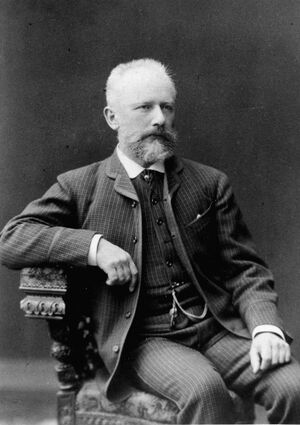
Premiered in 1878, Tchaikovsky’s 4th symphony is an exciting battle between the individual and Fate. Written in gratitude to the composer’s “best friend,” the symphony is dedicated to Tchaikovsky’s patron, Nadezhda von Meck. Meck was an extremely wealthy Russian widow, and was a huge fan of Tchaikovsky’s music. It was owing to this fact that the composer received a sizable stipend through 1877, allowing him to pursue composition fully. The relationship had a rather strange air about it, however, as while Meck was an admirer of Tchaikovsky’s works, her donation to the composer came with the stipulation that they must never meet in person, their relationship remaining solely epistolary (Dotsey). Nevertheless, it was the gratitude that the composer felt toward his wealthy patron that spurred his creative process, and the result was a truly stunning piece of music.
It is impossible to truly understand the 4th symphony without addressing the issue of its programmatic nature. In simpler terms, does it tell a story? The short answer, most certainly, is, “yes?” The more complex answer is found in one of the letters written by Tchaikovsky to Meck in which he responds to this very question. The letter begins with Tchaikovsky elucidating the subtleties of musicality; that is, the story and soul in music. The composer likens the creation of music to that of literature: “Essence distilled into sounds,” he writes, “in the same manner in which a lyrical poet expresses himself in verse. The only difference is that music has much more powerful means and a more subtle language with which to express thousands of different emotions and frames of mind.” The letter then broadens to further capture the methodology behind Tchaikovsky’s creative process. It’s all an incredibly fascinating read, one which I wholly recommend. Diving deeper into the letter, Tchaikovsky begins to spell out his version of the story behind his 4th symphony.
  • Length: ~45 minutes
  • Structure: This piece is composed of 4 movements
  • Sound:
    The piece begins with the introduction of the “Fate” motif in the brass, immediately introducing the driving force behind the symphony. In his letter, Tchaikovsky describes “Fate” as, “that fateful force which prevents the impulse to happiness from attaining its goal. Now, this definition of fate brings new light into the meaning of this piece. Tchaikovsky suffered with bouts of depression all throughout his life, and to him, this musical expression of “Fate” may be a manifestation of his own internal battles. The introductory theme gives way to a much more bleak and hopeless melody passed between the strings and woodwinds. Other emotions manifest themselves in the music—sadness, happiness, longing—but all are suppressed by “Fate.” These emotions battle throughout the entire first movement until the very end, when “Fate,” described by the composer as akin to the sword of Damocles, delivers a climactic, killing blow.
    The second movement is a complete shift in tone. It takes on a much more melancholy feel that Tchaikovsky describes as the feeling “which comes in the evening when, weary from one’s toil, one sits alone with a book — but it falls from his hand.” The movement feels like it is lost in the past, manifesting the good and the bad, but altogether forming a mood that can only be described as bittersweet. In the simplest terms, it feels like getting lost in one’s memories. There are phrases and passages rich with joy and happiness that are so immersive and tangible, yet the music always returns to the bittersweet longing that so characterizes this movement.
    The third movement is the “odd duck” of the four. Tchaikovsky himself describes it as having “no specific feeling.” The entire movement has this incoherent air about it. I would say the best way to describe it is almost as a dream, or otherwise the first stages of drunkenness. It seems to drag the listener out of the “real” world and into a strange interphase.
    “The fourth movement. If within yourself you find no reasons for joy, then look at others.” The final movement of Tchaikovsky’s 4th symphony is nothing less than victory made manifest. Triumphant melodies in the brass and strings truly convey a sense of overcoming. However, even in this victory, “Fate” finds a way to resurface, momentarily interrupting the festivities; a reminder that even when we seem to have triumphed, the battle is never truly over. This interruption is short-lived though, as a victorious melody in the brass carries us to the end of the piece. More than a finale, this movement is a statement: “Joy is a simple but powerful force. Rejoice in the rejoicing of others. To live is still possible.”
The fourth symphony is one of my favorite pieces of classical music, and one that I relate to in a deeply personal way. Of course, the interpretation of the music I gave you today is just one way of perceiving it. You might hear this piece and think of something completely different, but that’s the beauty of music. For me, this piece is perfect for lengthy drives or for laying in bed after a long day.

The performance I have for you today is by the Frankfurt Radio Symphony Orchestra under the baton of Carlos Miguel Prieto.

Dotsey, Calvin. “A Battle With Fate: Tchaikovsky’s Symphony No. 4.” Houston Symphony, 11 January 2018, https://houstonsymphony.org/tchaikovsky-symphony-4/. Accessed 20 September 2026.

Tchaikovsky, Pyotr Ilyich. Letter 763. Tchaikovsky Research, https://en.tchaikovsky-research.net/pages/Letter_763. Accessed 20 September 2026.

Read More Blogs and Get Your Dose of Classical Music

About Sam

Samuel “Sam” Miller is a 12th grade student at Gonzaga Preparatory school who writes and distributes a weekly classical music blog that shares different classical songs and explores their background with his teachers and peers. He is an avid violinist studying under Mateusz Wolski, and an enthusiastic member of the Spokane Youth Symphony. Samuel started this project to pursue and share his passion for classical music with others. In his free time, Sam enjoys practicing violin, going to symphony concerts, playing tennis, hanging out with friends, video games, and spending time with his family.