


Symphony Review: Symphony preparation, knowledge and accuracy make for strong opening concert
By Larry Lapidus
The Spokesman-Review
September 21, 2026
The 81st season of the Spokane Symphony got going over the weekend with two concerts at the Martin Woldson Theater at the Fox. Music Director and Conductor James Lowe presented three works that displayed not only the orchestra’s ability to entertain its audience but also to deepen their knowledge and appreciation of the universe of orchestral music.
The program consisted of works by two Russian composers of the Soviet era, Dmitri Kabalevsky (1904-87) and Sergei Prokofiev (1891-1953), and the American composer Amy Beach (1867-1944), whose ground-breaking Gaelic Symphony was performed by our orchestra in 2023 under the direction of Morihiko Nakahara. American pianist Mackenzie Melemed was soloist in the Beach Concerto.
The orchestra that filled the stage on Saturday night was not exactly the same as the one that gave us such a brilliant performance of the Verdi Requiem at the end of April. In case anyone is worried that it might have been adversely affected by the long summer hiatus or by significant changes in its personnel, let me set their minds at ease. It is true that the Principal Percussionist, Leigh Wilson, the Principal Flute, Joanna Wu, the Interim-Principal Cello, Alan Okhubo, the Second Horn, Henry Nordhorn, the Principal Timpanist, Ben Blaesing, and the Principal Trumpet, Jack Farnham, all appeared in those roles for the first time at these concerts.
Despite changes in personnel, the Spokane Symphony is playing as powerfully, as beautifully and as accurately as ever. Lowe could hardly have chosen an opening work that better displayed these qualities than the Overture to Dmitri Kabalevsky’s comic opera “Colas Breugnon.” It begins with a raucous fanfare that employs a tricky syncopation, then launches into a theme that requires the entire orchestra to play rapid passagework in perfect unison and very softly. To judge from the Spokane Symphony’s rendition, there was no difficulty involved. Just relaxed, frothy music-making. As the piece progresses, Kabalevsky assigns a solo turn to each section of the orchestra, requiring them to demonstrate their skill at bowing, blowing into or striking their instruments.
In his pre-concert lecture, Lowe framed the program as an illustration of how three musicians responded to harsh restrictions placed on them by the societies in which they lived. Like all artists during the reign of Joseph Stalin, Kabalevsky and Prokofiev lived under constant threat of intimidation, denunciation or death if their work happened to displease the Dear Leader and be condemned as transgressing the bounds of “Soviet Realism.” Kabalevsky responded by dutifully toeing the line and producing a body of work free of negativity and ambiguity, much less criticism of the state.
The American Northeast following the Civil War was a society in which one was relatively free of such restrictions, so long as one were a man. Though she was born with manifestly precocious musical talent, Beach was forbidden by her husband to obtain a formal education in music composition, which would have violated the standards of what he regarded as respectable society. It is instructive to compare her case with that of Clara Schumann, whose Piano Concerto we heard at a Masterworks concert last April. Accordingly, Beach was compelled to acquire her considerable skill at harmony and orchestration through private study, while matters of musical form and development remained less developed. She went on to establish herself not only as a successful composer, but also, like Schumann, a celebrated piano virtuoso.
The fullest flowering of this preparation is the Piano Concerto in C-sharp Minor she completed in 1899, which rather magnifies the qualities of Schumann’s Concerto: colorfully written for orchestra, brilliant in its exploitation of piano technique but structurally and thematically vague. What was certainly not vague is Mackenzie Melemed’s mastery of the piano part in Beach’s Concerto, or, for that matter, any other piano part of any concerto. The Beach Concerto opens with a quiet, mysteriously lyrical introduction in the orchestra (quite the most interesting part of the work), which is interrupted by a fortissimo interjection by the piano.
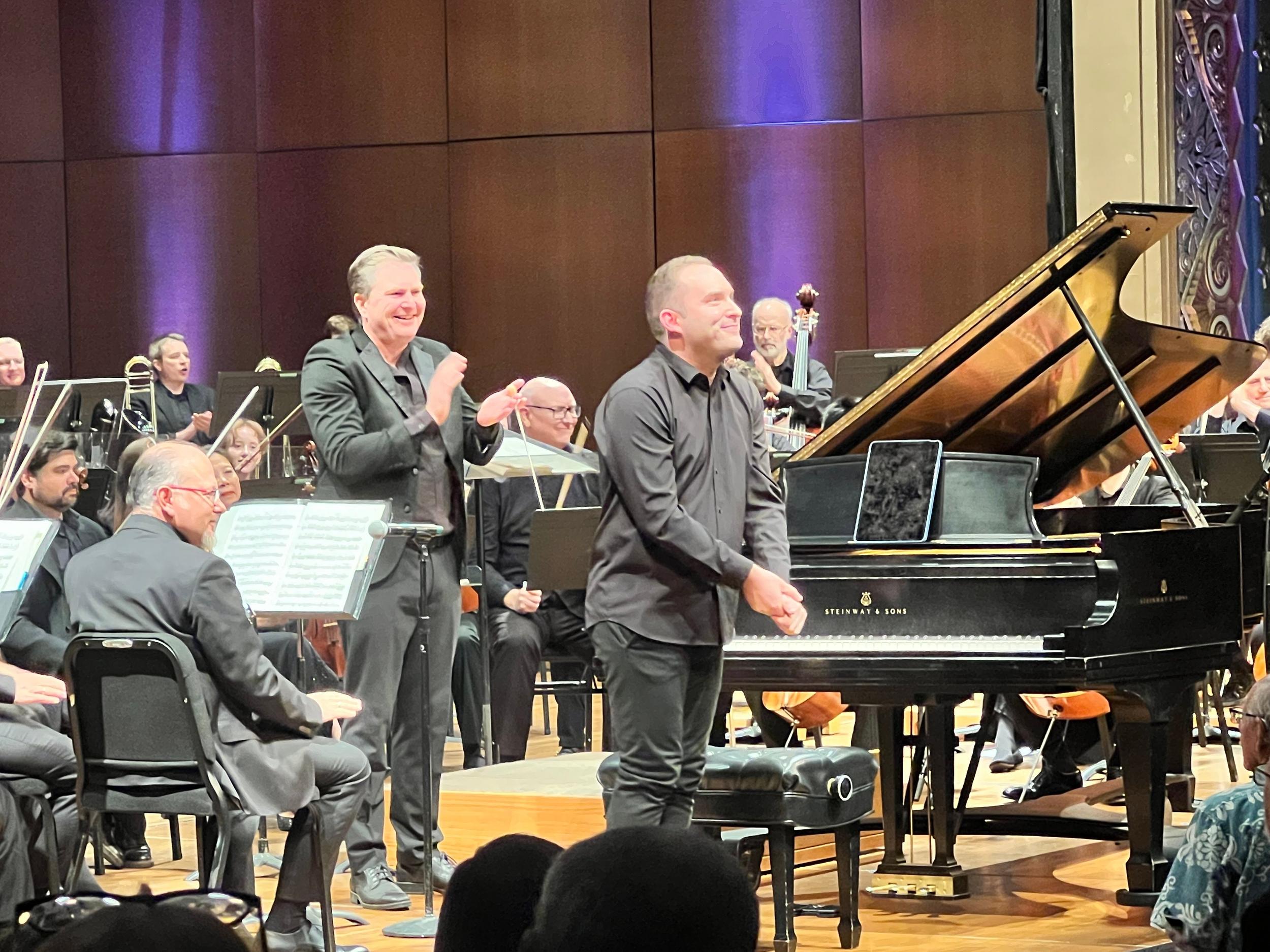
For purposes of describing Melemed’s performance, “volcanic” is a suitable translation for fortissimo. What is significant is not the fact that Melemed can play loudly, but that his technique is so perfectly developed that it can encompass such astonishing production of tone within its normal compass, without lunging or lifting his hands above his head or indulging in any other dramatic, attention-getting antics.
The same technical preparation allows him to play softly without losing projection, or quickly without losing accuracy. Whether it was in scale passages or octave fusillades, delicate tracery or singing legato, or any other of the many challenges with which this concerto confronts the soloist, Melemed demonstrated abilities at a level that was scarcely credible. To express the excitement generated by Melemed and the orchestra, the audience applauded after every movement, and rose to their feet at the conclusion of the work. They also acknowledged the vision and determination of the composer, who chose to set herself against the prejudices of her class that would have confined her to the exigencies of dusting and darning.
To Kabalevsky’s skill and Beach’s moral courage, Sergei Prokofiev added a capacity for artistic vision – or simply, genius – that exceeded both in producing his ballet, Romeo and Juliet, which must be ranked among the dozen or so greatest musical works of the twentieth century. Its greatness lies not merely in the wealth of melody it contains or the inexhaustible brilliance of its orchestration, but in its capacity to plumb the tragic nature of human existence. Like the three composers on the program, Romeo and Juliet were driven to fulfill their own hopes for happiness, only to be brutally confronted by the demands and restrictions of class and clan. Prokofiev’s astonishing achievement is in capturing the complexity of tragedy, in which the audience feels simultaneously the innocent hope of the protagonists and their knowledge of its ultimate outcome, and does so without language, but wholly in the medium of sound.
Exactly how Prokofiev manages to capture Shakespeare’s tragic insight in music is certainly beyond the scope of this article. It was not beyond Lowe’s scope, however.
Prokofiev’s technique might be described as musical irony: the crafting of a score that simultaneously imparts an awareness of opposing thoughts or feelings. He will, for example, clothe melodies of great beauty with orchestral sounds that are harsh or threatening. In some instances, he will start a melody in the warm mid-range of the violas and cellos, only to transport it suddenly into the highest range of the violins and woodwinds, where the rich harmonics and sensuous vibrato we find so comforting are no longer available. He will ask the flute to play a skipping, lighthearted melody, only to accompany it with grinding dissonance in the basses.
There is scarcely a bar in “Romeo and Juliet” that does not show signs of this curdling double vision, and to convey it consistently and comprehensibly to an audience requires that a conductor have a very keen and attentive pair of ears and a group of players capable of making audible to others what he or she wants to hear. This is precisely what we were able to enjoy on Saturday night at the Fox. The result was a rendition of the score that brought the actions of Shakespeare’s doomed lovers to life before us, though no one onstage was dancing.
This was done by deploying a wider range and variety of tone than one ever recalls hearing from the Spokane Symphony. It ranged from diaphanous clarity – more like melody remembered than actually heard – to a darkly saturated tone of relentless menace. All sections, but especially the violins, exhibited a willingness we had not heard before to press their instruments for all the tone they could comfortably deliver, and a bit more. Alan Ohkubo led the cello section through passages that were played with a mixture of passion and ferocity that was literally breathtaking.
So effectively did Lowe and his orchestra render Prokofiev’s concluding depiction of the stillness of death at the end of the program that he felt it necessary to send us away with a heart-lightening performance of a brief excerpt from another Russian work: the cheerful Gopak from Modeste Mussorgsky’s unfinished opera, “Sorochyntsi Fair.”
