


Masterworks 1: The Mahlers
September 13, 2025 - September 14, 2025
See and Download your Red Carpet Photos Here
Saturday Night Gallery
Sunday Matinee Gallery
James Lowe, conductor
Ashley Dixon, mezzo-soprano
We open our 80th season with Mahler’s titanic First Symphony; a vivid journey from mysterious dawn through fanfares, folk dances, and intense struggles, culminating in a blisteringly triumphant finale. Gustav Mahler forbade his new wife Alma from composing, claiming, “There is room for only one composer in the family.” We present some of Alma’s early songs, revealing a talented composer lost to the world.
Alexander Zemlinsky
Intermezzo from Act I of Es war einmal… (Once upon a time…)
Alma Mahler
Sieben Lieder (orchestrated by Colin & David Matthews)
Gustav Mahler
Symphony No. 1 in D major, “Titan”
SATURDAY DOORS 6PM | PRECONCERT LECTURE 6:30PM | SHOW 7:30PM
SUNDAY DOORS 1:30PM | PRECONCERT LECTURE 2PM | SHOW 3PM
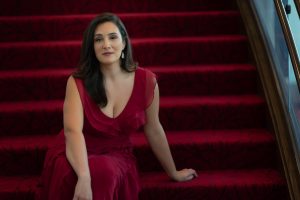
Photo Credit: John Myers
Mezzo-soprano Ashley Dixon is a bright shining star on today’s opera and concert stages. She begins her 2025-26 season performing Alma Mahler’s Sieben Lieder in her debut with the Spokane Symphony led by James Lowe. Ms. Dixon will make a role and house debut with the Virginia Opera as Elizabeth Van Lew in Jake Heggie’s contemporary opera Intelligence. She will revive her portrayal of Mozart’s Zweite Dame in Die Zauberflöte in Simon McBurney’s production at the Festival d’Aix-en-Provence under the baton of Leonardo García Alarcón with stage direction by Clément Cogitore as well as with Opera San Antonio in the internationally acclaimed production by Barrie Kosky and the British theater group 1927. She joins the Chattanooga Symphony and conductor Ilya Ram for a performance of Verdi’s Requiem. Ms. Dixon will give a recital and masterclass at University of North Florida.
Last season, she performed Les Nuits d’été of Hector Berlioz with the Indianapolis Chamber Orchestra under the baton of Matthew Kraemer and joined the roster of Lyric Opera of Kansas City to cover Rosina in Il Barbiere di Siviglia with a team that included conductor James Lowe and stage director Morris Panych. Ms. Dixon conducted a masterclass at the University of Indiana. In previous seasons she performed with the Chicago Symphony Orchestra as The Queen in Mendelssohn’s oratorio Elijah with James Conlon on the podium; returned to the San Francisco opera to sing Zweite Dame in Die Zauberflöte in the inventive production from Barrie Kosky and Suzanne Andrade with Music Director Eun Sun Kim on the podium; joined Houston Grand Opera to cover the role of Elizabeth Van Lew in the world premiere of Intelligence, a new work from composer Jake Heggie and librettist Gene Scheer, conducted by Kwamé Ryan; and sang the demanding role of Adalgisa in Bellini’s bel canto masterpiece Norma with Palm Beach Opera led by conductor Carlo Montanaro and director Keturah Stickann as well as with the Boston Youth Symphony conducted by Federico Cortese and Joshua Major on stage direction. Her concert appearances included the Elgar’s Sea Pictures with the Coastal Symphony of Georgia led by Music Director Michelle Merrill on the podium; Mozart’s Requiem with the Fort Wayne Philharmonic conducted by Andrew Constantine; and joining a gala celebration with New Orleans Opera as a guest for Lisette Oropesa in Concert conducted by Joseph Colaneri.
Recent engagements include her critically acclaimed debuts with LA Opera in Roberto Devereux (Sara) under the baton of Eun Sun Kim and alongside bel canto veterans Ramon Vargas and Angela Meade as well as Amarillo Opera in Il barbiere di Siviglia (Rosina). On the concert stage she made debuts with Erie Philharmonic in Mozart’s Requiem and Boston Philharmonic for performances of Beethoven’s Symphony No. 9 at Symphony Hall in Boston and Carnegie Hall, and returned to the Ravinia Festival for Beethoven Symphony No. 9 and Die Zauberflöte (Zweite Dame); debuts at Opera Louisiane in the title role of Bolcom’s Lucrezia, Hawaii Opera Theatre in The Tragedy of Carmen (Carmen), Festival Opera in Norma (Adalgisa), and Tel Aviv Summer Opera in Carmen (title role); and a return to the Ravinia Festival for La clemenza di Tito (Annio) conducted by James Conlon and San Francisco Opera for a Schwabacher Debut Recital. She also embarked on a duet recital tour with her husband tenor Carlos Santelli. Ms. Dixon has made formidable debuts with Detroit Opera (née Michigan Opera Theatre) in Copland’s The Tender Land (Mrs. Splinters); Ravinia Festival in Ravel’s Shéhérazade. ; Des Moines Metro Opera in La Traviata (Flora); and workshopping Laura Kaminsky’s Hometown to the World: Postville (Linda Larsen) in addition to participating in San Francisco Opera’s “Opera for all Voices.”
Ms. Dixon made her San Francisco Opera main stage debut in the world premiere of Heggie’s It’s a Wonderful Life (Angel First Class). During her two-year tenure as an Adler Fellow, she was seen in Carmen (Mércèdes), Rusalka (Third Wood Sprite), Manon Lescaut (Italian Singer), and Hansel and Gretel (Sandman). As a two-year participant in the Merola Opera Program, she was seen in Gianni Schicchi (La Ciesca), Menotti’s The Medium (Mrs. Nolan), Walton’s The Bear (Popova), and ended her summer season on the stage of the War Memorial Opera House, singing an aria from Cendrillon as part of the Merola Grand Finale concert.
Ms. Dixon continued to perform amid the pandemic joining The Atlanta Opera for her house and role debut as Carmen; was also a soloist in San Francisco Opera’s Holiday Gala alongside Michael Fabiano and Sondra Radvanovsky; and appeared as a featured guest artist with Opera San José as well as joining West Edge Opera for Elizabeth Cree (Doris). Ms. Dixon has cultivated a passion for French repertoire ranging from Baroque to Berlioz, with roles including Gluck’s Orphée, Cendrillon, Marguerite (La damnation de Faust), and Carmen. Additional roles in her formidable arsenal include the title roles of Ariodante, Giulio Cesare, and Angelina (La Cenerentola). Conductors with whom she has collaborated with include Marin Alsop, Patrick Summers, David Neely, Benjamin Zander, Jorge Parodi, Christopher Ocasek, Christopher Franklin, Clinton Smith, Robert Mollicone, Michael Ching, Bryan Nies, and Emily Senturia, in productions and stage appearances working with stage directors James Robinson, Tomer Zvulun, Fenlon Lamb, Mark Foehringer, and Karen Tiller,
Ms. Dixon earned her Bachelor of Music at the Louisiana State University and Master of Music at the University of Michigan, where she was seen in Handel’s Giulio Cesare (title role) and Heggie’s Dead Man Walking (Sister Helen Prejean). Ms. Dixon is a Grand Finals Winner of The Metropolitan Opera National Council Auditions.
Thursday, September 11 at noon, Music Director James Lowe gives you the “LoweDown” on the music. It’s a free, fascinating, and lighthearted talk about the music, including historical context and meaning, juicy gossip about the composers’ lives, music clips, visuals, and our conductor’s quick wit!
◆ 12:00 to 1:00 PM
Northwest Museum of Arts and Culture’s Eric A. Johnston Auditorium, 2316 W. First Avenue, Spokane
Experience a behind-the scenes look at how Masterworks performances are perfected. Watch the inner workings of the orchestra as James, the musicians, and our guest artist shape and polish each work in the final rehearsal. Enjoy a mimosa, coffee, and locally-baked pastries.
Tickets: $32
Purchase a subscription of all 3 for $87
DOORS 9AM | SHOW 10am – Noon
Ticket includes one mimosa, coffee, and pastries.
ALL MASTERWORKS AND MIMOSAS
MW1 – Saturday, September 13, 2025
MW4 – Saturday, January 17, 2026
MW9 – Saturday, May 9, 2026
Whether you couldn’t attend a Masterworks concert or loved what you heard and want to listen again, Spokane Symphony Masterworks concerts are featured on SPR Classical’s “Concert of the Week,” the Saturday after each performance on KSFC 91.9 FM at 12pm on spokanepublicradio.org.
Program notes by J. Michael Allsen
Our opening concert, titled “The Mahlers” is devoted to turn-of-the-20th-century Viennese music by Gustav and Alma Mahler, and by Alexander Zemlinsky, opening with an enjoyable orchestral intermezzo from one of Zemlinsky’s operas. Then we sample orchestral versions of several of Alma’s hyper-romantic songs, performed by mezzo-soprano Ashley Dixon. After intermission, we hear Gustav’s magnificent first symphony.
The brilliant Alexander von Zemlinsky, very much part of the circle around Gustav and Alma Mahler, composed his fairytale opera Es was einmal… with help from Gustav Mahler, for a production at the Vienna Court Opera. The Intermezzo is a light piece that is played at one of the pivotal moments in the plot.
Alexander von Zemlinsky
Born: October 14, 1871, Vienna, Austria
Died: March 15, 1942, Larchmont, New York.
Intermezzo from Es war einmal…
- Composed: 1897-99.
- Premiere: January 22, 1900, at the Vienna Hofoper.
- Duration: 5:00.
Background
Born in Vienna, Zemlinsky was at the forefront of Austrian music at the turn of the 20th century. He largely supported himself as a conductor, first in series of opera theaters in Vienna, and then in Prague and Berlin, with frequent engagements across Europe. He was also an influential teacher—his more notable composition students included Arnold Schoenberg (who also became his brother-in-law), Anton Webern, Alban Berg, and Erich Korngold. As a composer, his first success came in the 1890s, after his training at the Vienna Conservatory. Several of his chamber works were performed at the prestigious concerts of the Tonkünstlerverein, where he attracted the complimentary attention of Johannes Brahms, who helped him publish his works. Zemlinsky’s Jewish background made life in Berlin increasingly difficult, and he left Nazi Germany in 1933 to return home to Vienna, only to flee once more in 1938 after the Nazi Anschluss in Austria. His last years were spent in New York, in ill health due to a 1939 stroke, and relative obscurity.
Zemlinsky worked closely with Gustav Mahler, who was a profound influence on the younger composer. In his powerful position as director of Vienna’s Court Opera he was in a position to help. Mahler decided to stage Zemlinsky’s second opera, Es war einmal… (Once Upon a Time…). This had a fairytale plot based largely on a story by Hans Christian Andersen, by way of an 1885 play by Danish painter and playwright Holger Drachmann. The libretto of Zemlinsky’s opera was drawn from an 1894 German translation of the play. Mahler worked intensely with Zemlinsky on the score, making adjustments in orchestration, vocal parts, and even cutting and extending various factions—including a sizable expansion of the Intermezzo heard here. The premiere, a lavish production at the Hofoper in January 1900, was an enormous success. Zemlinsky’s admiration for Mahler remained boundless: small wonder that when he and Schoenberg founded the ambitiously named Vereinigung Schaffender Künstler (Society of Creative Artists) a few years later, Mahler was named honorary chair.
Zemlinsky’s relationship with Alma Mahler was a bit more fraught. In 1900, the 29-year-old Zemlinsky began teaching composition lessons to 21-year-old Alma Schindler. In early 1901, they fell in love, though they kept their very physical affair secret from Viennese society. (It was not Alma’s first go-round; she had earlier carried on a chaste affair with painter Gustav Klimt.) Her family did everything it could to discourage the relationship between her and a man that they considered to be beneath her. For her part, she treated Zemlinsky shabbily: complaining about his looks and making nasty antisemitic comments. Their affair apparently continued until it was brought to an end by her new affair with Gustav Mahler in November 1901. For his part, Zemlinsky seems to have hurled all his feelings about his relationship with Alma into an extravagantly passionate orchestral work titled Die Seejungfrau (1902-03) based upon Andersen’s tale The Little Mermaid.
What You’ll Hear
The Intermezzo comes at the end of a long prologue that sets the scene: a spoiled princess dismisses suitor after suitor with mockery and scorn. The Prince of Nordland arrives with his companion Kaspar to ask for the princess’s hand but gets the same treatment. The prince gives as good as he gets, and she eventually condemns him to death unless he will kneel for mercy. He refuses, and she storms off, leaving the wily prince to start what has apparently had been as his plan from the start. During the Intermezzo, he and Kaspar transform themselves: the prince reappears disguised as a vagabond, and Kaspar takes the role of his drunken mother. Don’t worry…it all turns out well: after a series of plot twists that involve a supposedly magical kettle, the princess is sent away with the vagabond by her exasperated father, and it ends happily ever after. This lively orchestral piece begins with lighthearted and folksy music for the prince and his pal. A magical harp interlude leads into a more romantic theme, perhaps foreshadowing the genuine tender feelings the princess will eventually have towards this vagabond. It ends with a reprise of the opening mood.
Alma Mahler, wife of Gustav, is a complex figure with a sometimes-troubling history. Here, the Spokane Symphony presents orchestral versions of seven of her passionate, late romantic songs.
Alma Mahler
Born: August 31, 1879, Vienna, Austria.
Died: December 11, 1964, New York City.
Sieben Lieder, orchestrated by Colin and David Matthews
- Composed: most of these songs were written in 1990 and 1901. The orchestral version heard here was published in 1995.
- Duration: 17:00.
Background
Alma was born Alma Schindler, daughter of a well-known landscape painter father and a mother who had been an operetta star. Alma was beautiful and brilliant; musically, she was talented and ambitious—one of her musical goals was to write the first significant opera by a woman. In 1902, Alma married Gustav Mahler, who was nearly 20 years older than her. He made it clear—in a 22-page letter—that there was room for only one composer in the family, and she apparently abandoned serious work in composition after that. (Gustav apparently relented in 1910, when he arranged for publication of five of her songs.) She did compose a few works after this, only 17 of her nearly 50 songs survive, most of them published in 1910 or in the years after Gustav’s death. When he died, Alma took charge of her husband’s legacy, eventually publishing his letters, her diaries, and two different memoirs. Though Alma was certainly the closest witness to Mahler’s life, her accounts have been shown to be doctored and flawed—so much so, that Mahler’s biographers talk about an “Alma Problem” with regards to taking her at face value.
Alma became famous, or infamous, for marriages to influential artistic men. Husband No. 2 was the architect Walter Gropius, with whom she had been having an affair in the last years of her marriage to Mahler. She carried on an affair with Huband No.3, poet and novelist Franz Werfel through most of her marriage to Gropius. Like Zemlinsky, she and Werfel fled Austria in 1938, settling in Los Angeles until his death in 1945. She remained an active socialite and hostess through the rest of her life.
It’s common to think of Alma Mahler-Werfel (the name she adopted on her tomb) as a self-aggrandizing monster, as a conceited dragon, and as someone who espoused ugly antisemitic views while married to prominent Jewish men: Mahler and Werfel. However, in the last few years, she has had a bit of a reconsideration and rehabilitation. People are complicated, and a more balanced view of Mahler-Werfel has emerged in recent years, as in a recent New Yorker essay by critic Alex Ross. Perhaps in the end her songs—hyper-emotional, irrational, and enigmatic—are the best way to approach the composer herself.
What You’ll Hear
The seven songs heard here were assembled and orchestrated in 1995 by the British brothers, Colin and David Matthews. Their orchestrations of the original piano accompaniment are sensitive and inobtrusive. Die stille Stadt (The Silent City) is appropriately dark and somber, reaching a peak of creepiness during the second stanza, but a children’s praise song cuts through the gloom at the ending. Laue Sommernacht (Mild Summer Night) opens with a sliding, chromatic woodwind line that is picked up by the singer in setting this upbeat poem. Licht in der Nacht (Light in the Night) is a perfect musical picture of a woman waking afraid in the dark, being comforted by the light of a distant star, and soothing herself to sleep again. Waldseligkeit (Forest Bliss) features a surprisingly uneasy background beneath a lyrical vocal line, though accompaniment and singer come together in an ecstatic passage at the end. The fifth and longest song, In meines Vaters Garten (In My Father’s Garden), is an impressive display of Mahler’s subtlety as a composer: it starts as a simple folk-like setting of this seemingly naïve folk poem, but develops constantly over the course of the song. Listen, for example, to her ever-changing setting of the repeated words süsser Traum (sweet dream) at the end of each stanza. In Bei dir ist es traut (I am at ease with you) the singer’s line intertwines quietly with oboe and other solo woodwind lines. In the final song of this set, Mahler works with another long poem, Erntelied (Harvest Song). Her setting begins with bright optimism but works towards a grand dramatic climax on the words, Gram der Nacht (grief of night). This is quickly dispelled by the cheerful conclusion, however. At the end, she sets an exuberant, wordless tag to the poem.
Mahler’s first symphony cost him a lot of work, and the final version, completed some 20 years after he started, is a weighty, late romantic symphony in four movements. The opening movement is light and pastoral, its main theme drawn from an earlier, lighthearted song. The second movement evokes the sound of Austrian military bands. The third is a doleful—and droll—funeral march, based upon a well-known children’s tune. The final movement progresses from a violent opening to a triumphant conclusion.
Gustav Mahler
Born: July 7, 1860, Kalischte, Bohemia.
Died: May 18, 1911, Vienna, Austria.
Symphony No. 1 in D Major
- Composition: Mahler composed much of this symphony between 1883 and 1888, but it was revised extensively over the next eleven years.
- Premiere: The composer conducted the premiere in Budapest on November 20, 1889.
- Duration: 53:00.
Background
Composing a symphony—particularly a first symphony—is a daunting task for any composer, and it often takes a good deal of time (Brahms’s first was not completed until he was 43). Mahler’s monumental first symphony is no exception: well over twenty years elapsed between his earliest sketches and the published version heard on this program. The earliest bit of sketch material that survives is a draft of the scherzo, possibly written as early as 1876. He began work in earnest in 1883, and by 1888 he had completed the earliest version of the symphony, an immense five-movement work. When he conducted the premiere of the work in Budapest in 1889, it was listed in the program as Symphonic Poem in Two Parts with the movements disposed as follows: Part I — 1. Introduction and Allegro comodo / 2. Andante / 3. Scherzo; Part II — 4. In the style of a funeral ceremony 5. Molto appassionato. Four years later, when Mahler conducted the work’s second performance in Hamburg, he revised the score extensively and affixed a new title, Titan, after a novel by Jean Paul Richter. While he retained the structure of the original symphonic poem, he gave programmatic titles to each of the movements: Part I: “From the days of youth”: 1. “Endless Spring” / 2. “A collection of flowers” / 3. “Under full sail”; Part II “The Human Comedy”: 4. “Funeral march in the style of Callot” / 5. “From the Inferno to Paradise”
Over the next six years, Mahler’s conception of the work changed one more time. When he published the score in 1899, it was with considerable revision and without the fanciful titles. As he wrote to the critic Max Marschalk in 1896:
“…at one time, my friends persuaded me to provide a kind of program for the D Major symphony in order to make it easier to understand—therefore I thought up this title [Titan] and explanatory material after the actual composition. The reason I have left them out is not only that I find them completely inadequate (and not even accurate), but also that I have learned through past experience how audiences have been misled by them. But that is the way with every program!”
The published score was presented simply as Symphony No.1 in Four Movements for Large Orchestra. Mahler had revised the music and dropped the original second movement. (Over the past fifty years, this “flowers” movement has occasionally been revived and included in performances of the Symphony No.1.)
This first symphony was not an immediate critical success, but Mahler himself was satisfied with the work. Writing to his friend and protégé Bruno Walter from New York in 1909, after he had led the New York Philharmonic in a performance of the Symphony No.1, he declared that he was “…really pleased with my youthful effort.” After his death, Mahler’s music lost popularity, and it wasn’t until the 1960s that his symphonies began to regain a firm place in the repertoire. The Symphony No.1, in many ways the most direct and easily grasped of his works, was one of the first of his ten symphonies to be revived and it remains the most popular.
What You’ll Hear
The opening movement, marked Langsam (slow), begins in a hazy, undefined mood, with insistent “cuckoo” calls in the woodwinds—this same interval, a descending fourth, will eventually begin the movement’s main theme, and will recur many times during the course of the symphony. Distant brass fanfares and more bird calls from the clarinet lead smoothly into the main theme of this movement. Mahler further identifies the feeling of this movement with the words schleppend wie ein Naturlaut (drawn out, like a sound of nature), and nothing could be more natural than this lovely melody. The theme is taken from the happiest movement of Mahler’s 1883 orchestral song cycle Lieder eines fahrenden Gesellen (Songs of a Wayfarer), the song Ging heut’ morgern übers Feld—one of the earliest of Mahler’s many self-quotations. This pastoral song begins with a dialogue between the singer and a cheerful finch:
“I walked this morning over the fields—dew still hung upon the grass. The merry finch spoke to me: ‘ Hey you! Isn’t it a good morning? Isn’t it? You there! Isn’t it a lovely world? Tweet tweet! Beautiful and sweet! How I love the world!’”
This theme is heard first in the low strings and is quickly picked up by the entire orchestra. The theme twice builds towards a climax before we return rather suddenly to the hazy mood of the opening. Intensity builds in leisurely way towards a final development. A return of the trumpet fanfare from the introduction signals the beginning of the coda, which is dominated by the brass and which comes to an abrupt, almost tongue-in-cheek ending.
Mahler marked the scherzo movement Kräftig bewegt, doch nicht so schnell (with strong motion, but not too fast). With its robust character, it closely resembles the Laendler, a rustic triple-meter Austrian dance. Mahler was closely tied to the Austrian music he had heard as a youth, and much of this movement emulates the sound of dances played by an Austrian military band. In the central section the Laendler gives way to a gentle and whimsical Waltz. The Laendler returns in an abbreviated form at the end of the movement.
In the published version of the Symphony No.1, Mahler rejected the notion of any programmatic element in the work. However, he did acknowledge that the third movement, fierlich und gemessen (solemn and with measured step), was inspired in part by a well-known illustration from a children’s book, a picture titled The Hunter’s Funeral Procession. Mahler evokes the satiric mood of this picture—forest animals pretending to be sad as they carry the hunter’s coffin—by adopting a minor-key version of the children’s tune Frere Jacques as the main theme. After developing this in rather doleful counterpoint, Mahler interrupts the music with a return to the country-band character of the previous movement (with a healthy dose of klezmer flavoring!). Frere Jacques returns briefly, only to be interrupted again by a long quotation from the despairing final song of Mahler’s “Wayfarer” cycle. The movement ends by combining the band music with the main theme and dying quietly away.
The final movement, marked Stürmische bewegt (with stormy motion), follows immediately after the end of third. This is a critical moment in the symphony, as Mahler explained in the 1896 Marschalk letter:
“…[in the third movement], the important thing is the mood which is expressed, from which the fourth movement then springs suddenly like lightning from a dark cloud. It is the cry of a deeply wounded heart, preceded by the spooky, ironically brooding oppressiveness of the funeral march.”
Mahler’s “lightning from a dark cloud” explodes with a cymbal crash and a dissonant brass chord. The minor-key main theme is heard first in the brasses and often takes on a rather violent marchlike character. The mood changes drastically with lyrical passage for the violins (perhaps the journey from Hell to Heaven described in Mahler’s Hamburg program). The violence returns again, only to resolve suddenly into a major key, and dissolve into a reminiscence of the opening of the first movement and a placid interlude. The marchlike theme returns once more, mingled with other fragments of other themes, building into a gigantic orchestral crescendo. The exultant coda is dominated once again by the brass, particularly by the eight horns. Bruno Walter best summarized the effect of this final movement:
“Here, he unleashes the tempest, a wild eruption, a life-and-death struggle leading to a triumphant conclusion.”
_____
Program notes ©2025 by J. Michael Allsen
The Masterworks 25-26 Season is Sponsored by

Bag Policy
All bags (with the exception of clutches 6 1/2 by 4 1/2 inches) are subject to visual inspection by venue security.
Large bags are not allowed in The Fox, and must be checked in our Coat Check (located in the North Gallery) for the duration of the event.
Programs are subject to change
Cancellation Policy
All sales are final and nonrefundable.
